2026 Freight Market Outlook
Four considerations for your supply chain strategy
-

-

-

-

-
CopyToClipboard
- 1. Market rate stabilization amid lingering uncertainty
- 2. Trade policy remains a persistent risk to market stability
- 3. Operational cost pressures and regulatory impacts challenge carriers and shippers
- 4. Supply chain resilience will be a competitive advantage
- Key actions to take now for your supply chain in 2026
1. Market rate stabilization amid lingering uncertainty
After several years of volatility driven by pandemic aftershocks, inflation, and geopolitical instability, transportation rates across most modes have stabilized and are expected to change only mildly in 2026. Cost pressures from inflation, labor, and regulatory compliance remain, but shippers may continue to benefit from a more balanced market. While spot rates have reached what could be considered the floor, continued pressure on carrier supply is likely to result in slight rate increases. Shippers are urged to build flexibility into their strategies, diversify sourcing, and align procurement with market cycles to ensure reliability and manage costs.
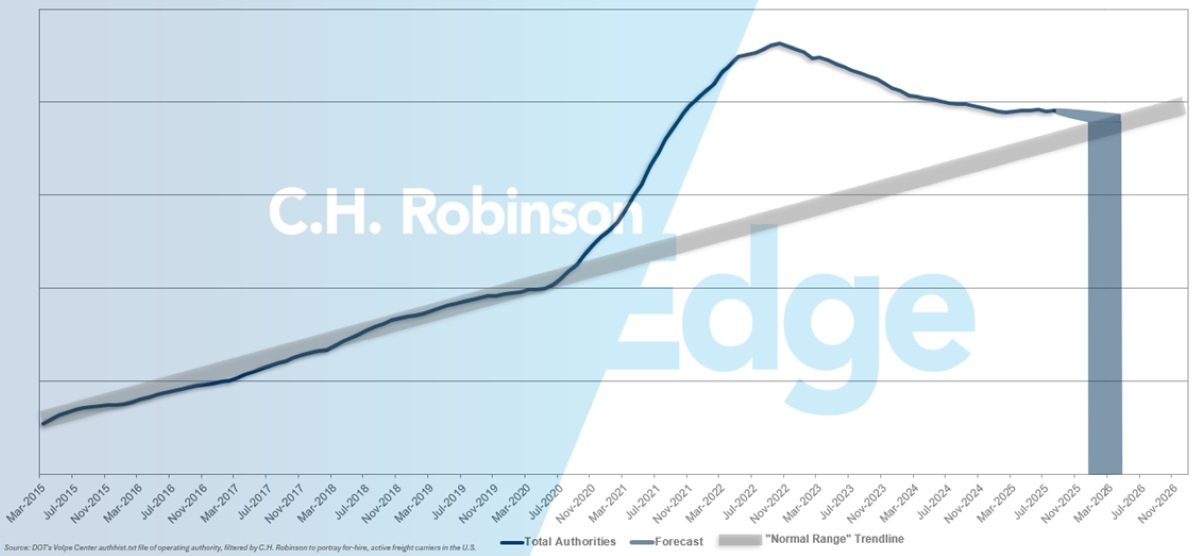
U.S. trucking: With little evidence of a material increase in freight volumes in 2026, truckload capacity is expected to return to more normalized levels in the first half of the year.
C.H. Robinson forecast of FMCSA carrier authorities
Less than truckload (LTL) tonnage is expected to remain slightly negative y/y for the first half of 2026 but inflect positively in the second half. To maintain service levels, mid-single-digit price increases are expected in 2026, which aligns with nearly 5% y/y average growth in the LTL producer price index (PPI) over the past three decades. It will be important to monitor the truckload market, as price increases typically result in freight shifting back to LTL and greater LTL rate increases as well.
Ocean: The gap between capacity and demand is expected to widen in 2026. With 1.5 million TEUs slated to join the global fleet, supply growth will outpace demand, reinforcing the market’s structural imbalance. Put simply, too many ships and not enough cargo. Ongoing disruptions in the Middle East, Suez Canal diversions, and congestion across Asian and European ports persist. These disruptions have temporarily tightened capacity, despite the oversupplied market, as longer transit times and port congestion keep vessels occupied and out of regular rotation. However, once carriers return to the Suez Canal—the timing of which remains uncertain—the overcapacity in the market would only increase as vessels shift back to shorter, more efficient routes.
Air: Global air cargo demand remains strong and is expected to continue into 2026, driven primarily by ecommerce growth outside the United States. Ecommerce shipments to the United States have been constrained by the removal of duty-free shipping and the broader economic landscape. While the end of the de minimis exemption for low-value shipments has had a pronounced impact on China-to-U.S. shipments, airlines have adjusted by reducing capacity in affected trade lanes. While this issue has been addressed in the short-term, it could impact y/y comparisons in early 2026 and may drive bulk consolidation or further nearshoring as retailers adapt.
U.S. Intermodal & rail: The cost advantage of intermodal over long-haul truckload remains between 10 and 15%, even during periods of extended low truckload rates. Rail’s slower transit time is still a barrier for time-sensitive freight, but improved reliability makes it more viable for shippers that can plan around one to three additional days in transit. C.H. Robinson offers an expedited intermodal service that typically costs approximately 10% less than truckload without requiring the same transit time concession.
Actionable tip: Consider diversifying your sourcing and remaining agile with your procurement strategies, keeping a close watch on transportation rate changes across different modes. Leveraging AI, like C.H. Robinson Agentic Supply Chain™ Solutions, to ensure diversified carrier strategies and scenario planning can help businesses manage costs and maintain reliability as market conditions shift in 2026.
2. Trade policy remains a persistent risk to market stability
Rapidly changing U.S. tariffs have been the most significant shock to supply chains in 2025. Trade policy continues to heavily influence the market, with new tariffs and more trade deals expected but details still uncertain. More policy adjustments are likely in 2026, prolonging uncertainty and influencing sourcing and trade behavior. Shippers should closely track tariff rates that significantly affect costs, especially when tariffs target specific commodities or goods from specific countries. These macro-economic conditions and unexpected trade decisions will remain a constant source of risk to market stability.
Ocean: Global containerized trade is projected to grow modestly in 2026, with regional performance varying based on economic conditions and trade flows.
- North American imports from Asia should remain strong but evolving trade policies and new tariffs are reshaping sourcing patterns. Rising U.S.–China tensions are accelerating a shift toward Southeast Asia, India, and nearshore markets such as Mexico, reducing China’s share of U.S. imports.
- In Europe, demand will remain constrained by sluggish GDP growth, while South America will present pockets of incremental opportunity.
Overall, shippers should prepare for continued policy-driven volatility, which will complicate long-term procurement and supply chain planning.
North American cross-border (US-Mexico, US-Canada): In 2026, Mexico is expected to further its role as a primary nearshoring hub, especially in automotive and computer/electronics manufacturing. Production capacity is projected to rise significantly as projects announced in 2024–25 come online. This will continue to rewire North American supply chains. Instead of as many China-originated goods flowing through U.S. ports, more finished goods and intermediate parts will move northbound from Mexico.
Canada’s role is expanding on two fronts: as a partner in energy transition supply chains (critical minerals, EVs), and as a balancing partner for U.S. sourcing diversification. Canada–Mexico direct trade, while smaller in volume, is expected to grow as Canadian raw materials and parts feed into Mexican manufacturing, leveraging the Canadian Pacific Kansas City (CPKC) single-line rail network as a north–south backbone.
Border capacity constraints will remain a defining issue in 2026.
Actionable tip: Closely monitor global trade developments—especially those affecting key regions like China, Southeast Asia, India, Mexico, and Canada—to mitigate risks and optimize procurement decisions. Proactively plan for alternative routes and cross-border logistics, particularly in anticipation of ongoing border capacity constraints and policy-driven volatility in 2026.
3. Operational cost pressures and regulatory impacts challenge carriers and shippers
While many operational cost pressures and regulatory impacts for carriers may have a direct impact on trucking, other modes and services will feel indirect impacts as tightened capacity and higher rates ripple across the supply chain.
Regulatory environment: Several recently announced regulations will be a factor in carrier supply in 2026.
- Tariffs on heavy duty trucks, steel, and aluminum: The tariff on metals has been effective for most of 2025, and for heavy duty trucks is expected to go live November 1, 2025.
- Changes for non-domiciled commercial driver's licenses (CDL): Including stricter rules on renewing CDLs for drivers residing in another country or state.
- English language proficiency for drivers: A safety requirement that has begun to place drivers out of service if they cannot communicate in English sufficiently.
- FMCSA registration modernization: An improvement to the Federal Motor Carrier Safety Administration’s (FMCSA) website requiring facial identification.
- H-2B visas: A pause on issuing specific work visas that some drivers use to operate in the United States.
These regulations will each have an impact on reducing or preventing new carrier entrants in 2026. The cumulative impact is likely to build throughout the year.
Fleet size: Class 8 tractor orders remain subdued. Manufacturers developed new technology to meet 2027 U.S. emissions requirements for heavy duty trucks but have held off putting it into production until there is certainty about whether these regulations will be enforced. Environmental Protection Agency (EPA) review of the 2027 standards is still under review. If emission standards do tighten, a pre-buy of 2026 equipment is expected in the second half of the year to get ahead of the additional costs associated with 2027 equipment.
Impact on capacity and rates: The compounding effects of regulation and higher operational costs are expected to accelerate carrier attrition from the market. Steady capacity reduction is then expected to create modest rate increases. Spot rate changes tend to influence contractual rates, though this dynamic varies depending on the phase of the market cycle. Broadly speaking, when transitioning from a soft to tight market, contractual rates follow spot rates more closely than when transitioning from a tight to soft market.
The spot market is expected to remain flat y/y in the first quarter of 2026, then slowly increase each quarter. Contractual pricing will depend on market conditions, shipper-specific variables, and the timing of renewals; however, significant rate increases are not expected in 2026 compared to 2025.
C.H. Robinson evaluates our spot market forecast each month based on economic and market conditions. For the most recent forecast, go to the truckload section in the latest C.H. Robinson Edge Report.
Seasonal impacts: One dynamic that became evident in 2025, and is expected to intensify in 2026, is short-term pressure on capacity and rates during seasonal events—both expected (such as DOT’s Roadcheck Week or produce season) and unplanned (such as weather disruptions or import surges). While the market remains oversupplied relative to stubbornly soft freight volumes, these shocks will be short-lived. Once the market reaches equilibrium, they could trigger more volatility in service levels and rates.
Actionable tip: Plan accordingly, for both full-year trends and these temporary disruptions. Despite a reasonably favorable environment for shippers, C.H. Robinson is forecasting a low single-digit increase in spot rates for 2026. Rationalizing your carrier base before the RFP process is an effective method to mitigate supply chain costs while identifying providers that best align with your strategic goals.
4. Supply chain resilience will be a competitive advantage
Facing softer consumer demand and uncertainty surrounding tariffs, shippers will be challenged to maintain supply chain stability and optimize costs. Key strategies include modal shifts, freight consolidation, carrier base rationalization, reducing manual interventions, and leveraging technology for scenario planning. These proactive measures are more effective than simply hoping for lower market rates. Trends like reshoring, nearshoring, and supply chain diversification are gaining momentum to mitigate tariff impacts, though they introduce new operational complexities. Stabilized rates and adequate capacity will provide opportunities for shippers to optimize networks and build resilience for the year ahead.
When the low-hanging fruit of transportation rate decreases is no longer available, it doesn’t mean opportunities for cost savings have disappeared. Shippers who want to strengthen resilience and control costs in 2026 should look at creating sustainable savings regardless of market cycle. There are three core areas of opportunity for companies seeking to create structural cost advantages: transportation strategy, process change, and data and decision intelligence.
Transportation strategy—aligning design with market reality: A resilient transportation strategy starts with understanding what you can control, and what you can’t. Rate cycles, capacity, and global events are external forces that may be out of anyone’s control, but contracting, consolidating, and network design are internal levers.
- Rationalize your carrier base: Fewer, stronger partnerships lead to better performance and lower costs over time. Strategic relationships allow providers to bundle services and offer competitive pricing even during tumultuous times. There are efficiency and communication benefits from this as well.
- Consider tender lead times: Years of research show that longer lead times lead to reduced rates and higher acceptance of tendered volumes from providers. Freight shipping is dependent on positioning equipment and without the proper planning, last-minute repositioning can be expensive or potentially impossible.
Process change—eliminating waste and manual intervention: Process inefficiency is often an invisible cost. Even in stable pricing environments, shippers miss out on margin through time, labor, and execution gaps. The ways to enhance processes are unique to each supply chain, but here are a few examples that can also create stability during volatile times.
- Automation and visibility: Digitize shipment tracking, tendering, and exception management to reduce manual intervention and improve accuracy. Identifying labor-intensive, repetitive tasks is a good first step in identifying strong areas for automation.
- Cross-functional alignment: Ensure procurement, transportation, finance, and other departments share performance metrics, so savings in one area don’t create costs in another. Alignment across these business functions decreases friction and allows for synergies when working together.
Data and decision-making—turning knowledge into action: Most companies have data that is often overlooked or under-utilized. Data-driven organizations turn information into powerful tools to not just monitor but to control costs. Here are some examples of how.
- Digital twin systems: Cutting edge companies are creating a duplicate system that runs in parallel to live data, allowing them to model total landed costs based on various hypothetical situations. This allows for an accurate evaluation of impact while factoring downstream risks.
- Predictive analytics: Using A.I. and forecasting tools to anticipate future demand in each lane can increase internal metrics as well as providing transportation partners with more accurate and plannable volumes. Increased intelligence can lead to more competitive rates, decreased detention and accessorials and reduced friction.
Actionable tip: Proactively invest in digital scenario planning and regularly review your modal mix and carrier base to stay ahead of tariff-driven disruptions and changing demand. By combining freight consolidation strategies with technology-enabled visibility and flexible sourcing (such as nearshoring and diversification), leaders can swiftly adapt to market changes, optimize costs, and strengthen overall supply chain resilience for the year ahead.
Key actions to take now for your supply chain in 2026
Strategically align your freight: Shippers should avoid treating 2026 as a “status quo” year. With tariffs, regulatory shifts, and seasonal shocks driving volatility, contracting strategies should be flexible. Blanket contracts for all your lanes may limit agility and result in cost unpredictability when awarded carriers reject inconsistent freight, and it ends up in the spot market with little lead time. The optimal approach will be blended procurement: securing core lanes through contracts while bundling spot freight for opportunistic buying in markets where rates soften. Timing matters. Align RFPs with expected rate cycles rather than rigid annual calendars to optimize both service and cost.
Be flexible across transportation modes: The relative competitiveness of modes will continue to evolve in 2026, with the truckload market as the bellwether for the entire industry. When supply-demand dynamics begin to tighten for truckload, rates will increase. As this shift occurs, intermodal rates are expected to adjust in order to stay competitive. Small-sized shipments will convert to LTL, adding volume and pressure on common carriers. Truckload capacity constraints will ripple across modes, contributing to port congestion, and reduced vessel efficiency. As efficiency declines, higher-priority freight is likely to move by air. Regardless of a shipper’s primary mode of transport, monitoring the truckload market will be essential in 2026.
Reassess inventory strategies: With consumer demand moderating and tariffs reshaping import flows, shippers may need to reassess inventory strategies. The “just-in-case” inventories of the pandemic era are giving way to hybrid models that limit excess carrying costs and position goods closer to customers. In 2026, resilient networks will rely on regional distribution, cross-border diversification, and consolidation programs to smooth bottlenecks. Shippers should leverage network modeling or digital twin testing to evaluate trade-offs in sourcing locations, inventory placement, and transportation cost.
Map critical vulnerabilities: Uncertainty will remain high in 2026. Potential risks include labor actions at ports or railroads, geopolitical conflicts disrupting key shipping lanes, and climate-driven events such as extreme weather that halts capacity. Shippers should proactively map critical vulnerabilities across their supply chains, identify alternative routings or suppliers, and pre-negotiate contingency arrangements. Risk management is no longer a reactive function. It must be embedded in the budgeting and procurement cycle.
Embrace new technologies: AI-driven forecasting, centralized purchase order management, and end-to-end visibility should be the baseline expectations. Visibility is not just about knowing where freight is; it’s about decision speed and execution. In 2026, shippers should prioritize item-level planning for more precise inventory control and predictive analytics to enable proactive responses to disruptions. Partnering with a logistics provider who has deployed the latest Lean AI, and can instantly give you an Agentic Supply Chain, will give your business an edge in a shifting market.
In 2026, shippers face a market defined less by runaway volatility and more by structural forces such as tariffs, trade policy, seasonal shocks, and regulatory uncertainty. Success will come from balancing strategic procurement with spot market opportunities, actively optimizing mode mix as relative cost advantages shift, and strengthening inventory positioning to buffer against disruption without overextending working capital.
Technology and visibility tools are no longer differentiators but essential infrastructure, empowering shippers to anticipate changes, execute quickly, and maintain resilience in an uncertain global freight landscape.
- 1. Market rate stabilization amid lingering uncertainty
- 2. Trade policy remains a persistent risk to market stability
- 3. Operational cost pressures and regulatory impacts challenge carriers and shippers
- 4. Supply chain resilience will be a competitive advantage
- Key actions to take now for your supply chain in 2026